



Anti-dsDNA Antibody ELISA Kits
Anti-double stranded DNA (dsDNA) antibody is a kind of typical autoantibodies, and anti-dsDNA-IgG antibody is found with high incidence in systemic lupus erythematosus (SLE) patient blood. Anti-dsDNA titer in SLE blood closely related to DNA-anti-DNA complex titer and low complement level, and it serves as an important marker for the activity of the disease. In MRL/lpr mouse serum which is a representative model animal of spontaneous autoimmune diseases, autoantibodies are found such as IgG type rheumatoid factor (RF), IgM type RF, anti-single-stranded DNA (ssDNA) antibodies, anti-dsDNA antibodies, and anti-Sm antibody, etc.
Fujifilm Wako offers mouse anti-dsDNA-antibody ELISA kit. It enables numerical comparison between measurements by converting IgG-type dsDNA autoantibody titers in diseased mouse blood to units using a standard antibody titer calibration curve.
What is Anti-dsDNA Antibody?
Anti-dsDNA antibody against double strand DNA is called anti-nuclear antibody (ANA) as antibodies to ssDNA and histone. Autoantibodies against DNA are IgG or IgM type reacting with natural dsDNA, ssDNA, or both types.
Anti-dsDNA antibody is a kind of typical autoantibodies, and anti-dsDNA-IgG antibody is found with high incidence in SLE patient blood. Anti-dsDNA titer in SLE blood closely related to DNA-anti-DNA complex titer and low complement level, and it serves as an important marker for the activity of the disease. Spontaneous models similar to human autoimmune disease and inflammatory-induced models have been used for elucidation of the mechanism of autoimmune diseases and also in searching for new drugs. A representative model animal of spontaneous autoimmune diseases is MRL/lpr mouse, and it is useful for studies on incidence mechanism of autoimmune diseases including rheumatoid arthritis (RA) since MRL/lpr shows high incidence of lymph node tumor, nephritis, angiitis, and arthritis. Autoantibodies other than anti-dsDNA antibodies found in MRL/lpr serum are IgG type RF, IgM type RF, anti-ssDNA antibodies, and anti-Sm antibody, etc.
LBIS™ Mouse dsDNA-Antibody ELISA Kit
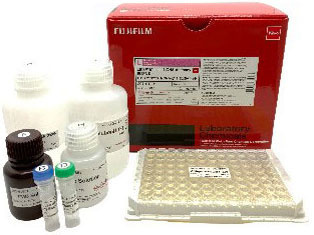
This kit is a sandwich ELISA system for quantitative measurement of mouse anti-dsDNA antibody titer1). It enables numerical comparison between measurements by converting IgG-type dsDNA autoantibody titers in diseased mouse blood to units using a standard antibody titer calibration curve.
Features
- Short assay time
- Assay with a tiny volume & diluted sample enable
- Eco-friendly preservatives used
- Ready to use - all attached reagents are solution-type
- High measurement accuracy and reproducibility
Kit Performance
| Analysis sample | Mouse Serum/Plasma |
|---|---|
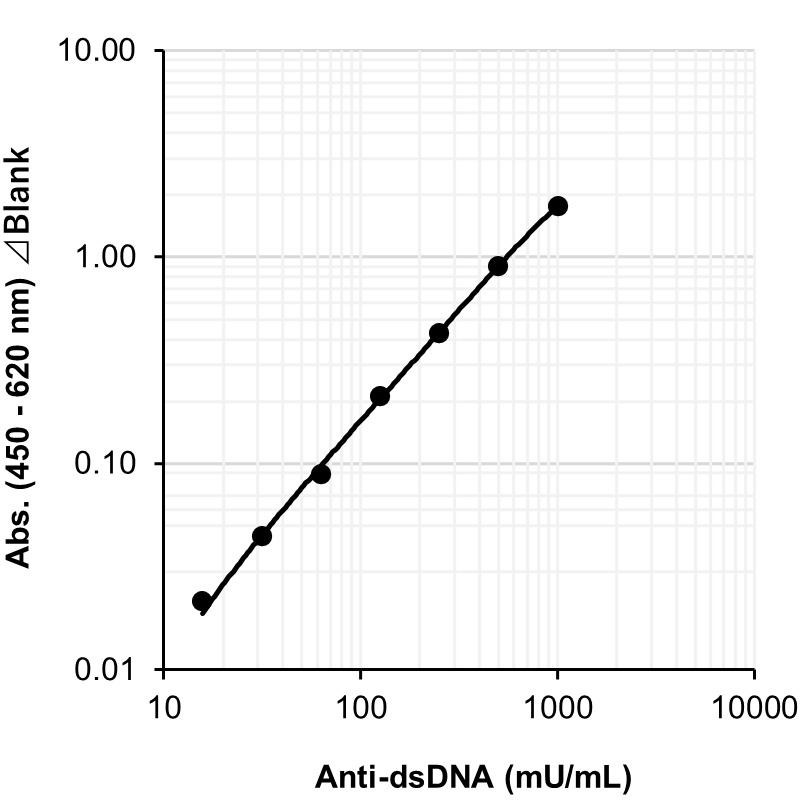
| Calibration curve range | 15.6-1,000 mU/mL |
| Sample volume | 5 µL (requires dilution*) |
| Measurement duration | Approx. 4 hours and 20 minutes |
| Detection method | Colorimetric (Primary: 450 nm / Refference: 620 nm) |
Example of Calibration Curve
Introduction of Research Papers
Our kit has been cited in publications in prestigious journals, including Cell and Immunity. The following are selected examples of its applications. In these studies, the kit was used to evaluate whether mouse models exhibited SLE-like phenotypes.
(1) Neoself-antigens are the primary target for autoreactive T cells in human lupus
Mori, S., Kohyama, M., Yasumizu, Y. et al.: Cell, 187 (21), 6071 (2024)
DOI: https://doi.org/10.1016/j.cell.2024.08.025
[Summary] : The study suggested that reduced expression of invariant chain (Ii) resulting from Epstein–Barr virus (EBV) reactivation may be one of the factors responsible for the presentation of neo-self antigens by MHC class II molecules. In this study, Fujifilm Wako's kit was used to analyze tamoxifen-inducible Ii-iKO mice. An increase in IgG-class anti-double-stranded DNA (dsDNA) autoantibody titers, which is frequently observed in patients with SLE, was similarly detected in these mice.
(2) Soluble CTLA-4 regulates immune homeostasis and promotes resolution of inflammation by suppressing type 1 but allowing type 2 immunity
Osaki, M. & Sakaguchi, S.: Immunity, 58 (4), 889 (2025)
DOI: https://doi.org/10.1016/j.immuni.2025.03.004
[Summary] : This study demonstrated that soluble CTLA-4 (sCTLA-4) produced by regulatory T cells (Tregs) suppresses type 1 immunity while maintaining type 2 immunity during chronic inflammation. In this study, Fujifilm Wako's kit was used to analyze mice with a specific deficiency in sCTLA-4 production. An increase in anti-dsDNA antibody production was detected in these mice.
References
- Kikukawa, T., Kojima, M., Abe, C.: Japanese journal of inflammation, 20 (6), 697 (2000).
A novel assay kits for autoantibodies rate on spontaneous autoimmune model mice - Mori, S., Kohyama, M., Yasumizu, Y. et al.: Cell, 187 (21), 6071 (2024)
Neoself-antigens are the primary target for autoreactive T cells in human lupus - Osaki, M. & Sakaguchi, S. Immunity, 58 (4), 889 (2025)
Soluble CTLA-4 regulates immune homeostasis and promotes resolution of inflammation by suppressing type 1 but allowing type 2 immunity
Product List
- Open All
- Close All
Anti-dsDNA Antibody ELISA Kit (mouse)
For research use or further manufacturing use only. Not for use in diagnostic procedures.
Product content may differ from the actual image due to minor specification changes etc.
If the revision of product standards and packaging standards has been made, there is a case where the actual product specifications and images are different.
The prices are list prices in Japan.Please contact your local distributor for your retail price in your region.