




[Technical Report] Verification of the Cell Death-Suppressive Effect of CEPT Reagent in Small-Scale Electroporation: A Comparison with the Conventional ROCK Inhibitor Y-27632
This article was contributed by Dr. Kimiko Kato, Department of Disease Model, Institute for Developmental Research, Aichi Developmental Disability Center.
Introduction
Human induced pluripotent stem cells (iPSCs), first established in 2006 by Dr. Shinya Yamanaka and colleagues, have become firmly established as a key resource in regenerative medicine and disease research. The following characteristics underlie the value of iPSCs:
Ethical advantage: Unlike embryonic stem (ES) cells, iPSCs can be generated from somatic cells without the use of fertilized eggs and are therefore subject to fewer ethical restrictions.
Construction of patient-specific models: iPSCs can be derived directly from patient-derived somatic cells, allowing the generation of disease models that retain the individual's genetic background. iPSCs are equally applicable to diseases of unknown genetic etiology.
Unlimited proliferative capacity and pluripotency: iPSCs maintain their ability to self-renew while being able to differentiate into all cell types derived from the three germ layers. Recent advances have further extended this potential to include induction into naïve iPSCs, 8-cell stage embryo-like cells, and trophoblast progenitor cells, as well as the generation of three-dimensional human embryo models (blastoids), enabling the recapitulation of various stages of early human development.
High compatibility with genome editing: Clones can be established from single cells, making iPSCs ideal for generating genetically uniform modified cell lines.
Applications for drug screening: iPSCs can be expanded at scale while preserving an identical genetic background.
In particular, the combination of genome editing technologies such as CRISPR-Cas9 with iPSCs has dramatically accelerated precise disease modeling through the introduction and correction of disease-associated mutations, as well as the analysis of gene function. However, electroporation--a highly efficient gene delivery method--typically requires large numbers of cells (usually 106 cells or more), and the high cost of iPSCs culture imposes a significant burden on research.
To address this issue, small-scale electroporation (104-105 cells) is a promising alternative; however, using fewer cells leads to a marked increase in cell death, presenting a significant challenge. iPSCs are particularly vulnerable to single-cell dissociation, and the conventional ROCK inhibitor Y-27632 often fails to provide adequate cytoprotection under small-scale conditions.
In this study, we investigated the use of the CEPT cocktail (Chroman 1, Emricasan, Polyamine supplement, Trans-ISRIB)1)2) with established cell death-suppressive properties to improve the viability of human iPSCs in small-scale electroporation. The primary objective was to demonstrate that CEPT provides superior cytoprotection over the conventional Y-27632.
| Method | Advantages | Disadvantages |
|---|---|---|
| Standard-scale electroporation |
|
|
| Small-scale electroporation |
|
|
| Lipofection |
|
|
Table 1. Gene delivery methods: advantages and disadvantages
Small-Scale Electroporation: Challenges and Strategies
As shown in Table 1, each method for introducing genome-editing plasmids and ribonucleoprotein complexes (RNPs) into human iPSCs involves inherent trade-offs.
The primary challenge in small-scale electroporation is the marked decrease in cell viability that results from using fewer cells. This is attributed not only to direct damage to the cytoplasmic membrane caused by electrical stimulation, but also to apoptosis triggered by a reduction in iPSC-specific cell-cell interactions (such as E-cadherin-mediated adhesion)3). To address this issue, the CEPT cocktail was expected to provide superior cytoprotection over Y-27632 by simultaneously inhibiting multiple cell death pathways.
Cell Lines and Reagents
- Human iPSC line: 201B7 (established using Yamanaka factors)
- Culture medium: AK02N (Ajinomoto Co., Inc.)
- Cell death inhibitors: CEPT cocktail (FUJIFILM Wako Pure Chemical Corporation) or Y-27632 (ROCK inhibitor; control group)
Electroporation Conditions
- Instrument: NEPA21 (Nepa Gene Co., Ltd.)
- Cell input: 5x10⁴-1x10⁵ cells/sample (small-scale conditions)
- Delivered gene/protein: 4 µg Cas9 (Nippon Gene Co., Ltd.), 1 µg gRNA (crRNA + ATTO550 tracrRNA, Integrated DNA Technologies, Inc.), 1 µg HDR plasmid
- Pulse conditions: See Table 2
| Voltage(V) | Pulse length(ms) | Pulse interval(ms) | Number of pulses | Decay rate(%) | Polarity switching | |
|---|---|---|---|---|---|---|
| Poring pulse | 125 | 5 | 50 | 2 | 40 | + |
| Transfer pulse | 20 | 50 | 50 | 5 | 50 | ± |
Table 2. Electroporation parameters
Evaluation Method
Occupancy-based evaluation: Cell occupancy was quantified by image analysis based on the local contrast differential method. In this approach, differences from the local background were calculated, and regions exceeding a defined threshold were identified as cells. Parameters were optimized according to sample characteristics, and detection results were verified visually.
Results
Comparison of the Cell Survival-Promoting Effects of CEPT and Y-27632
Cell viability evaluation based on cell occupancy revealed that the CEPT-treated group exhibited significantly higher cell survival than the Y-27632-treated group (Figure 1).
Using Y-27632 as the baseline (100%), the relative cell survival of the CEPT-treated group was 155.76 ±1.31%, indicating an approximately 1.56-fold increase in cytoprotection (p < 0.001, Welch's t-test). In addition, no significant difference was observed in the proportion of ATTO550-positive cells between the CEPT-treated and Y-27632-treated groups (data not shown), indicating that CEPT does not adversely affect gene delivery.
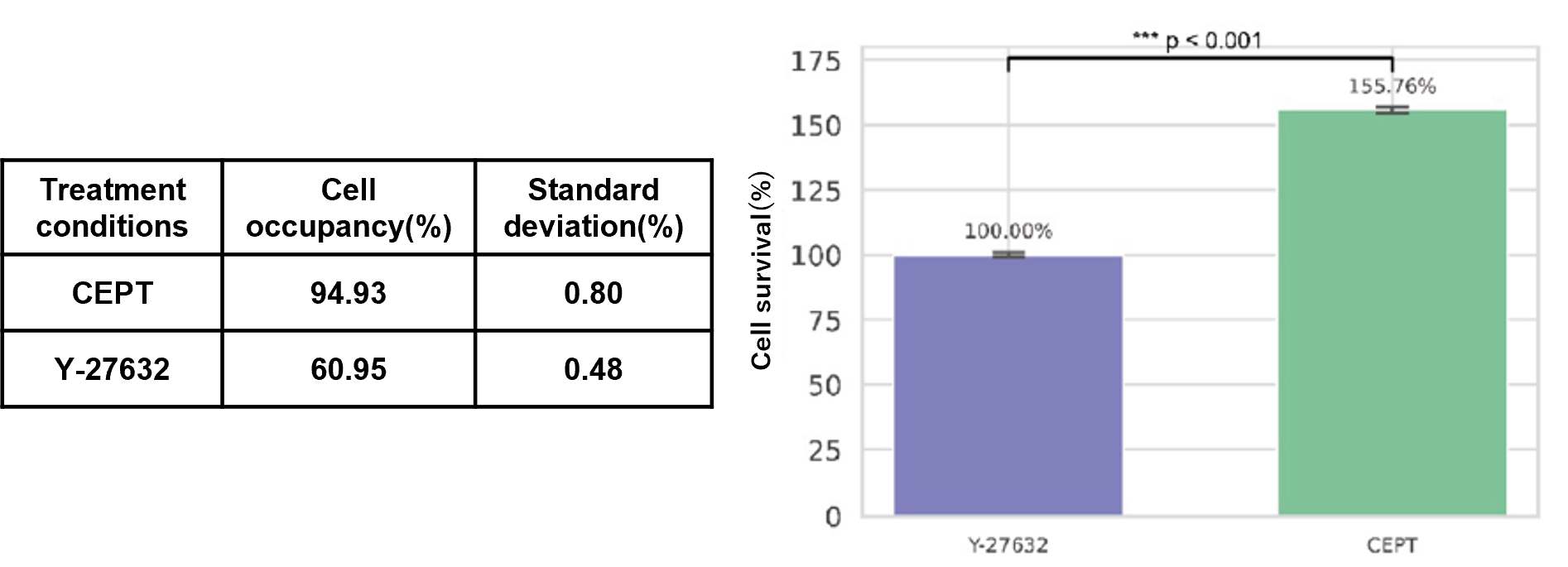
Figure 1. Cell death-suppressive effects of CEPT and Y-27632. CEPT markedly improved cell viability 24 hours after electroporation.
Discussion
This study demonstrated that CEPT (FUJIFILM Wako Pure Chemical Corporation) has superior cell death-suppressive properties over Y-27632. CEPT substantially reduces cell death--the primary challenge in small-scale electroporation--thereby enabling more efficient gene delivery under low cell-number conditions.
Conclusions
Recent accumulating evidence indicates that the CEPT cocktail enhances blastoid formation efficiency from naïve pluripotent stem cells (Yu et al., 2023, PMID : 37683605 ; Chen et al., 2025, PMID : 40961945 ; Pinzon-Arteaga et al., 2024, PMID : 39453814 ; Xie et al., 2025, PMID : 39814012). Although we were unable to confirm a promoting effect on reprogramming from primed iPSCs to naïve iPSCs (unpublished data), we plan to employ CEPT when inducing blastoid formation from naïve iPSCs.
References
- Chen, Y. et al. : Nat. Methods, 18 (5), 528 (2021).
- Fujifilm Wako Pure Chemical Corporation, CultureSure™ CEPT Cocktail(1,000×)
- Higo, S. et al. : Methods Mol. Biol., 2320, 235 (2021).
Related Products
For information on how to use this product and other applications, please visit our website.