



Glucagon ELISA Kits
Glucagon is a peptide hormone consisting of 29 amino acids secreted from the α cells of pancreatic islets of Langerhans. The main physiological function of glucagon is to decompose glycogen in the liver into glucose, increase blood glucose level, and keep glucose level constant with insulin.
What is Glucagon?
Glucagon is the most important counter‑regulatory hormone opposing insulin and has the effect of raising blood glucose levels. It is secreted by pancreatic α cells and mainly targets hepatic cells1-2). Glucagon is known to have the following three major physiological functions: glycogenolysis in the liver, stimulation of gluconeogenesis, and lipolysis in adipose tissue.
(1) glycogenolysis in the liver
Glucagon promotes the breakdown of glycogen stored in the liver, resulting in the release of glucose into the bloodstream.
(2) stimulation of gluconeogenesis
Glucagon promotes gluconeogenesis—the synthesis of glucose from non-carbohydrate substrates—and helps maintain blood glucose levels.
(3) lipolysis in adipose tissue
Glucagon promotes the breakdown of fat in adipose tissue, releasing fatty acids into the bloodstream, where they can be used as an energy source.
By binding specifically to glucagon receptors (GCGRs), glucagon promotes the degradation of hepatic glycogen, thereby raising blood glucose levels3).
GLP-1R, GCGRs, and glucose-dependent insulinotropic polypeptide receptors (GIPRs) play central roles in energy regulation and are therefore key therapeutic targets for metabolic diseases. Some mono-agonists that act on one of these receptors—such as GLP‑1R agonists—have already been developed. Current attention is focused on the development of triple agonists that activate all three receptors. Triple agonists have the potential to reduce the risk of both hyperglycemia and obesity, and several candidates have already entered clinical trials4).
Glucagon ELISA Kit Wako (Sandwich method)
Glucagon is a peptide hormone comprising 29 amino acids and secreted from α cells in the islets of Langerhans. Physiologically, it acts on liver to degrade glycogen to glucose and increase blood glucose levels. Together with insulin, it plays an important role in maintaining blood glucose level.
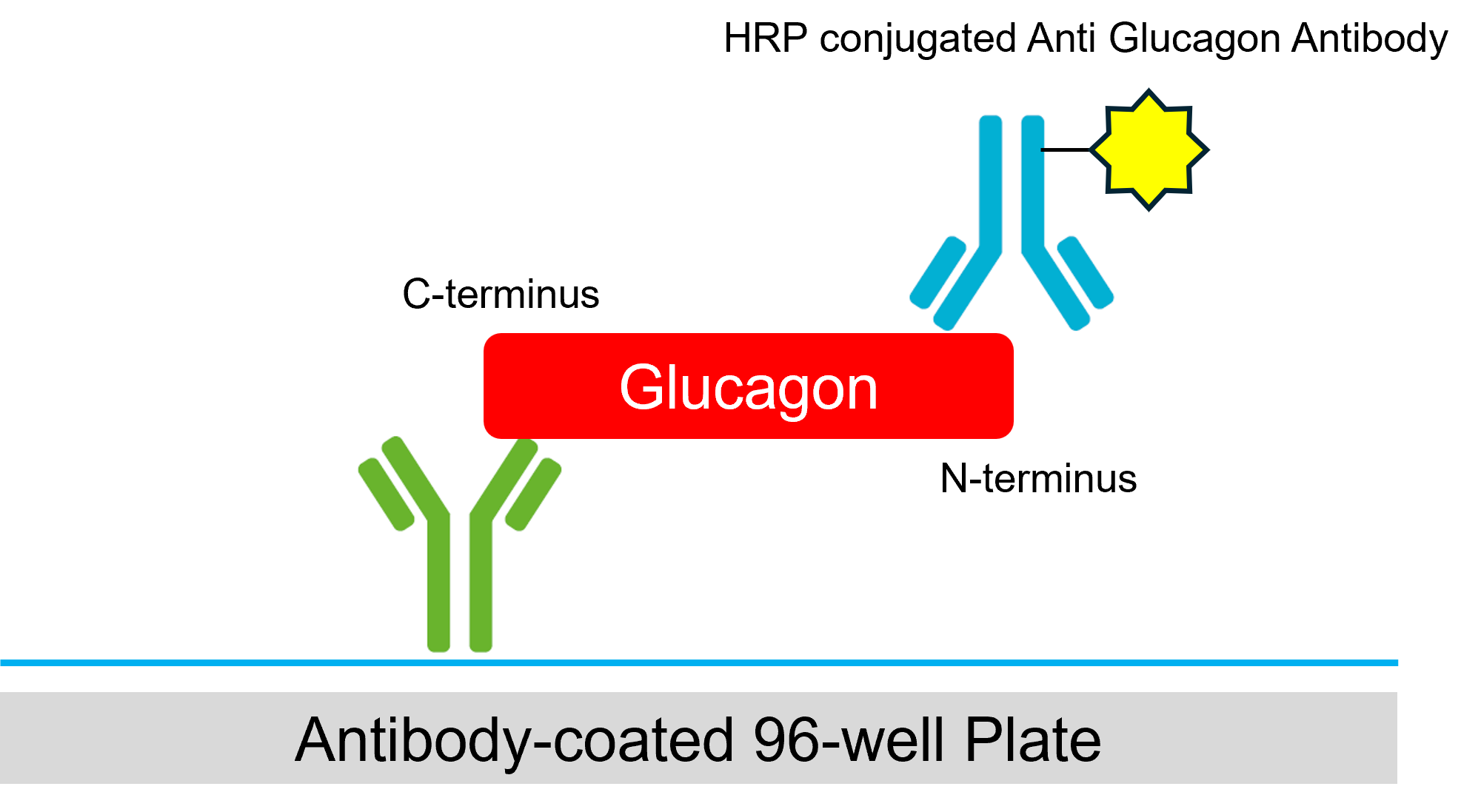
This kit is a sandwich ELISA for the quantitative measurement of glucagon in samples, using monoclonal antibodies that recognize the N- and C-terminus of glucagon, respectively. The assay with this kit shows low cross-reactivity, if any, to glucagon-related peptides such as glicentin, oxyntomodulin, GLP-1 or GLP-2.
Kit Performance
| Analysis sample | Human Serum/Plasma(EDTA) Mouse Serum/Plasma(EDTA) Rat Serum/Plasma(EDTA) Culture medium |
|---|---|
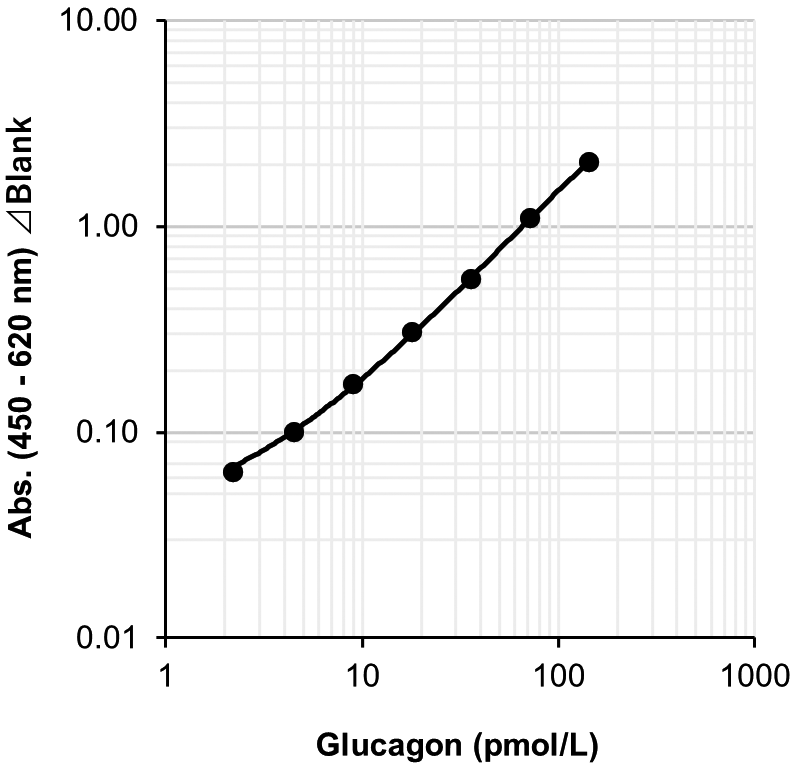
| Calibration curve range | 2.2-143.6 pmol/L (7.8-500 pg/mL) |
| Sample volume | 10 μL |
| Measurement duration | Approx. 20 hours |
| Wavelength | Primary wavelength 450 nm Reference wavelength 620 nm |
Example of Calibration Curve Range
Assay Principle
This kit is a sandwich ELISA that uses monoclonal antibodies recognizing the N- and C-terminus of glucagon. It enables highly sensitive measurement with a small sample volume of only 10 μL.
Cross-Reactivity
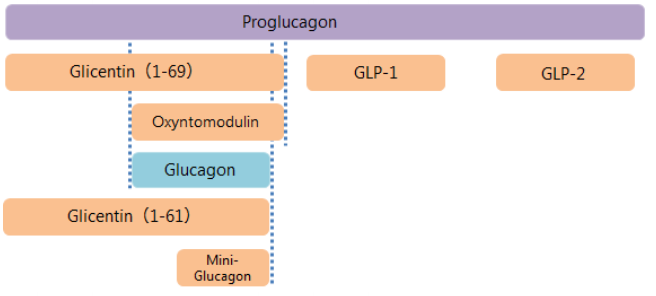
In addition to glicentin and oxyntomodulin, several other peptides structurally similar to glucagon have been identified. This kit has been confirmed to exhibit virtually no cross-reactivity with these related peptides.
| Species | Similar proteins | Concentrations (pmol/L) | Measurement value (pmol/L) | Cross-Reactivity (%) |
|---|---|---|---|---|
| Human | Glicentin (1-69) | 100,000 | 680 | 0.68 |
| Glicentin (1-61) | 100,000 | 950 | 0.95 | |
| Oxyntomodulin | 100,000 | 640 | 0.64 | |
| Mini-glucagon | 37,000 | N.D. | - | |
| GLP-1 (7-36) NH2 | 15,200 | N.D. | - | |
| GLP-1 (9-36) NH2 | 16,200 | N.D. | - | |
| GLP-2 | 13,300 | N.D. | - | |
| GIP | 4,000 | N.D. | - | |
| Mouse | Glicentin (1-69) | 100,000 | 970 | 0.97 |
| Oxyntomodulin | 100,000 | 640 | 0.64 | |
| GLP-1 (7-36) NH2 | 15,200 | N.D. | - | |
| GLP-1 (9-36) NH2 | 16,200 | N.D. | - | |
| GLP-2 | 13,200 | N.D. | - | |
| GIP | 4,000 | N.D. | - | |
| Rat | Glicentin (1-69) | 100,000 | 960 | 0.96 |
| Oxyntomodulin | 100,000 | 640 | 0.64 | |
| Mini-glucagon | 37,000 | N.D. | - | |
| GLP-1 (7-36) NH2 | 15,200 | N.D. | - | |
| GLP-1 (9-36) NH2 | 16,200 | N.D. | - | |
| GLP-2 | 13,000 | N.D. | - | |
| GIP | 4,000 | N.D. | - |
Correlation with Products from Other Competitors
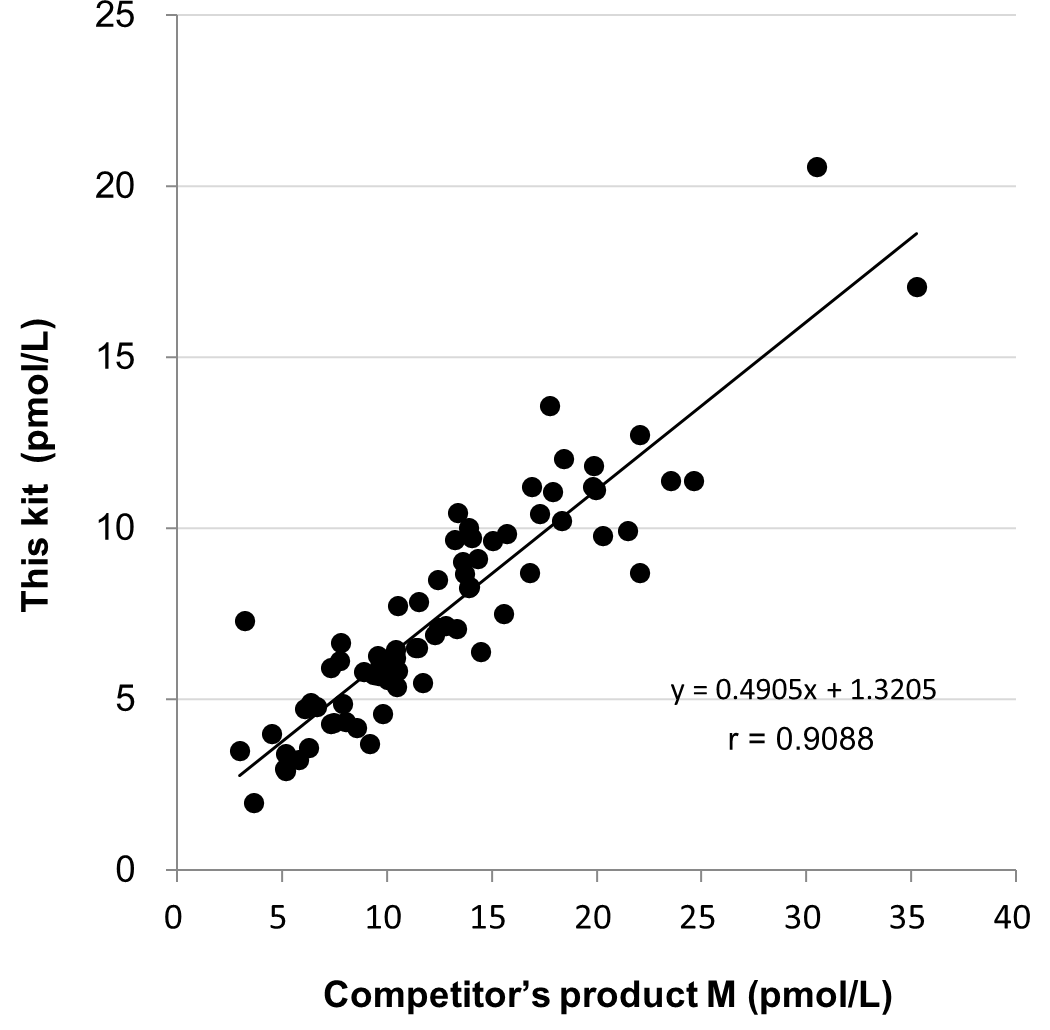
Measurements were conducted on the same samples (n=78) of serum from human using this kit and competitor's product M. The measurement values obtained using both products were then compared.
References
- John, H. F. & Willard, O. R. : ENDOCRINOLOGY., 54 (3), 303 (1954).
THE ACTIVITY OF EXTRACTED PANCREATIC HYPERGLYCEMIC-GLYCOGENOLYTIC FACTOR AFTER COBALTOUS CHLORIDE AND SYNTHALIN A - Vuylsteke, C. A. & de Duve, C. : Archives of Physiology and Biochemistry., 61 (2), 275 (1953).
[Influence of glucagon on the action of insulin] - Huypens, P. et al . : Diabetologia., 43 (8), 1012 (2000).
Glucagon receptors on human islet cells contribute to glucose competence of insulin release - Seidelmann, S. B. et al . : Lancet Public Health., 3 (9), E419 (2018).
Dietary carbohydrate intake and mortality: a prospective cohort study and meta-analysis
Product List
- Open All
- Close All
For research use or further manufacturing use only. Not for use in diagnostic procedures.
Product content may differ from the actual image due to minor specification changes etc.
If the revision of product standards and packaging standards has been made, there is a case where the actual product specifications and images are different.